


53rd Congress of the Spanish Academy of Dermatology and Venereology
Published on20 Maggio 2026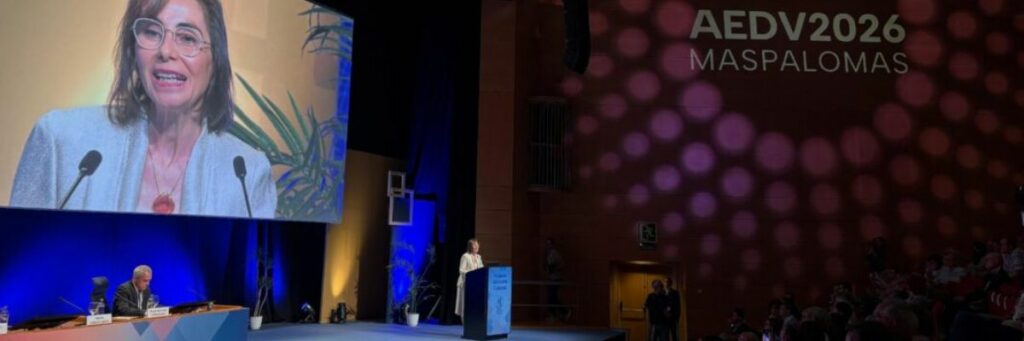
Migration, globalisation and scientific advances transform skin health in Spain
- Over 2200 dermatologists are meeting in Gran Canaria under the theme “Where Skin Breathes Science”, at the AEDV’s 53rd National Congress, where 337 speakers, with a notable international contingent, will offer over a hundred scientific sessions to review scientific developments in skin diseases
- With over 10 million residents born abroad and a greater diversity of phototypes and cultural practices, specialists are updating their approach to detecting and treating skin disease from a skin-of-colour perspective
- The scientific content of the Congress includes fields such as new treatments in inflammatory and rare diseases, intralesional therapies in skin cancer, dermatology and gender, and the role of the dermatologist in longevity, stand out among the scientific content of the Congress
Today, Spain has over 10 million inhabitants who were born abroad, bringing with them a greater diversity of phototypes, but also of cultural practices, imported and emerging pathogens, and dermatoses associated with living conditions. In Dermatology, is key to overcome the ‘exotic approach ’and update, through specific training, the knowledge of specialists, who treat increasingly diverse patients. This new situation, approached from a skin-of-colour perspective, and other parallel situations, such as the effects of climate change, together with new developments provided by skin research in recent years, such as biological therapies for inflammatory skin diseases, advances in dermatological oncology and major innovations in aesthetic medicine, have revolutionised this medical specialty whose focus is skin care.
For updates on the new scientific developments in inflammatory disorders, rare skin, oncology, dermatology and gender diseases, STIs, and aesthetic medicine, over 2200 dermatologists will gather from today until 23 May in Maspalomas (Las Palmas), for the 53rd National Congress of the Spanish Academy of Dermatology and Venereology (AEDV), the largest event in this specialty in Spain. At the congress, 337 speakers from hospitals throughout Spain and other international centres will offer over a hundred scientific sessions, including symposia, seminars and workshops.
At the presentation of the Congress, Dr Yolanda Gilaberte, president of the AEDV, announced that this year ‘we have four international speakers whose focus is on the topic of dermatological diseases in people with darker skin tones: Dr Susan Taylor, from the US and past president of the American Academy of Dermatology; Dr Ivonne Arellano, from Mexico, secretary of the International League of Dermatological Societies (ILDS); Dr Mariel Isa, from the Dominican Republic, secretary of next year’s World Congress of Dermatology; and Dr Rashmi Sarkar, from India, a member of the ILDS board’.
The AEDV president stated that all of them ‘have significant expertise in how skin diseases present on darker skins or in dermatoses that more frequently affect this type of skin, such as melasma’.
Different skin tones in clinical practice
Along these lines, Dr Ana Pulido, coordinator of the AEDV Infectious Diseases Group, mentioned a number of examples of the variety associated with different skin tones. In high phototypes, she noted, ‘erythema or reddening can be less evident or appear as blueish-purple, greyish or brownish in colour; inflammation more frequently leaves post-inflammatory hyperpigmentation or hypopigmentation; keloids, pseudofolliculitis, acne with dyschromia, traction alopecia’s and certain inflammatory diseases may have greater clinical significance.
As Dr Gilaberte stressed, ‘this is something that has traditionally been forgotten, even in dermatological texts, and which now is becoming increasingly evident in countries like ours, as we have more patients with darker skins, from Africa, Asia and Latin America’.
This oversight may lead to errors such as those outlined by Dr Pulido: ‘Underestimating erythema and inflammatory severity, which leads to delayed diagnosis in potentially severe diseases such as drug eruptions and psoriasis, and failure to recognise extensive tinea infections or those modified by corticosteriods. Diagnoses may also take longer due to lack of familiarity with dermatoscopic symptoms in high phototype skins and due to barriers to access or communication.’
To avoid such failings, the specialist noted the need for ‘specific training’, such as that provided in this congress, as well as ‘facilitating screening aimed at populations from endemic areas, where appropriate, and working in coordination with primary care, public health services and reception centres’.
Spain, candidate for the World Congress of Dermatology
At the press conference to present the 53rd Congress, Dr Gilaberte gave a brief appraisal of her four years as AEDV president, culminating in this meeting of the specialty. Together with efforts to ensure the Academy’s contribution to sustainability, she also highlighted that Spain is a candidate for hosting the 2031 World Congress of Dermatology in Madrid. The quality and relevance of dermatology research in Spain has led the AEDV to present its candidacy for hosting the event, one that brings together leading specialists from all over the world. ‘Spain is at the cutting edge of European and International Dermatology, making it the ideal place to hold the World Congress of Dermatology’, she concluded.
Dr Gilaberte also underlined the efforts made over the last four years in the field of sustainability. On this point, she highlighted how the AEDV, at this 2026 congress in Maspalomas, has become the first scientific society to join Iberia’s SAF Circle to reduce CO2 emissions from plane travel. ‘Given that most of participants have had to come by plane, we have signed an agreement with Iberia to join a business alliance to promote the use of sustainable aviation fuel (SAF). By doing so, the AEDV contributes to the purchase of part of this fuel, thereby reducing atmospheric CO2 emissions by 10%.’
During the congress presentation, Dr Isabel Belinchón, first vice-president of the Academy, stressed the importance of training and continual professional development for dermatologists. ‘Everything that contributes to improving training for dermatologists, from residency onwards, eventually has an impact on quality of care. A better trained, more up-to-date dermatologist who is more confident in their clinical practice is one that also provides better patient care.’
Dr Belinchón underlined that, with its Residents’ Campus and its Research Unit, which works with the Spanish National Research Council (CSIC), ‘the AEDV plays a key role in the necessary continual development of dermatologists’ knowledge, and this Congress is the leading event in our specialty for sharing and exchanging expertise’.
Disruptive therapies in skin cancer and inflammatory diseases
Dr Ricardo Fernández de Misa, executive president of the 53rd AEDV Congress, highlighted that the congress programme includes 724 scientific communications, 187 oral presentations and 530 posters. These communications, along with the 120 scientific sessions involving a dozen leading international speakers, will study the latest innovations in inflammatory diseases, skin cancer and aesthetic medicine, among other areas.
‘The scientific material we have this year in all fields of dermatology is outstanding,’ he stated, while providing a number of examples. ‘In melanoma and squaemous cancer, immunotherapy and intralesional therapies mean that patients who we were previously unable to treat can now be stabilised. In inflammatory diseases, biological drugs, monoclonal antibodies and, in the last few years, JAK inhibitors, which reduce the inflammatory response, psoriasis, hidradenitis, alopecia areata, vitiligo… A year ago for some of these, such as vitiligo, there were no clear evidence-based treatments, but there are now,’ noted Dr Fernández de Misa. In aesthetic medicine, ‘materials are being constantly perfected, techniques improved, dermatologist better trained…’. In this field, the congress will hold a special session on the role of the dermatologist in longevity.
Alongside the science, the congress has also organised a notable social programme. ‘At events such as the official inauguration this evening in Maspalomas, the charity dinner to collect funds for social causes and the closing dinner, attendees will be able to enjoy the science, but also the social side. Gran Canaria and Maspalomas have much to offer congress attendees, with beaches, gastronomy, atmosphere, safety and very welcoming people. Dermatologists from all over Spain will soon see this for themselves,’ he stressed.
Activities organised by the AEDV Piel Sana Foundation
As well as the scientific programme, the 53rd AEDV Congress, through the Piel Sana Foundation (Healthy Skin Foundation), will include activities aimed at the general public and patients. This was announced during the presentation by Dr Agustín Buendía, director of the AEDV Piel Sana Foundation. The activities include the ‘Two Protagonists and One Destiny’ meeting, on 21 May. This will be a space for dialogue and active listening between patients’ associations and expert dermatologists. From a shared perspective, the session will address pathologies such as epidermolysis bullosa, ichthyosis, hidradenitis suppurativa, vitiligo, chronic urticaria, atopic dermatitis, psoriasis and various autoimmune diseases such as lupus and dermatomyositis, focussing on the real needs of people living with them.
On the same day, as part of the congress, participants will be attending a charity dinner to support national, international and local projects.
The programme will also include a training talk aimed at workers in the hotel industry (23 May, Hotel Costa Melonera Auditorium), oriented towards reinforcing key knowledge regarding skin health in the context of high exposure to sunlight.
On the same day, the ‘Skin Issues’ initiative will reach out to the general public in Plaza del Faro in Maspalomas, with an information tent involving participatory activities, bilingual content (Spanish and English) and direct advice from healthcare professionals. The action will put particular emphasis on sun protection, prevention of skin cancer and sexually transmitted infections.
Dr Buendía noted that ‘giving voice to patients with pathologies such as psoriasis, atopic dermatitis and less frequent diseases, such as epidermolysis bullosa, is essential for a better understanding of their reality and to improve our approach’. He also highlighted that ‘these initiatives allow us to bring dermatology to contexts of daily life, promote prevention and self-care with rigorous and accessible information’. In his words, ‘our objective is to generate a real impact on people’s health through health education and dialogue with society’.
The AEDV meeting, whose theme is ‘Where Skin Breathes Science’ will, according to Dr Fernández de Misa, be ‘an opportunity for Canary Island dermatologists to show the whole country the great potential of our islands by holding a magnificent congress’.
Dr Yolanda Gilaberte closed the presentation of the 53rd AEDV Congress, the last to be held under her presidency, with a message defending dermatology and of optimism for the future. ‘Ours is one of the broadest, most attractive and innovative medical specialties. And this is shown by the fact that, once again this year, it was one of the most widely chosen specialties among first-year residents. We treat all age groups, we have a wide variety of sub-specialties and we have been pioneers in the use of tools such as artificial intelligence. Now we went to get ahead of new realities and refresh our knowledge to care for increasingly diverse patients.’

